







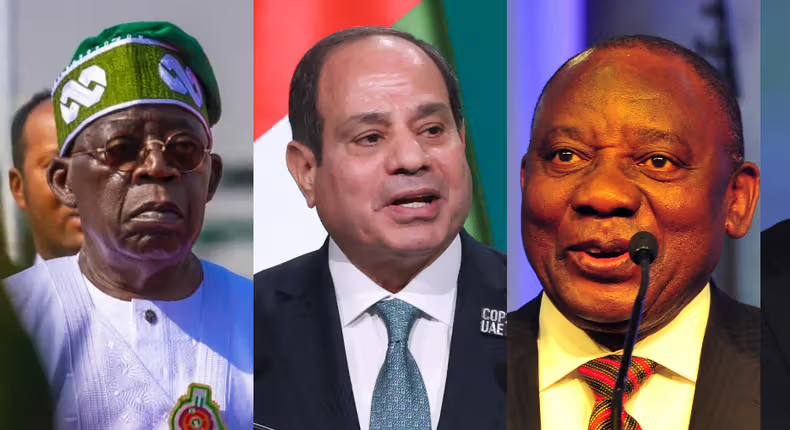
Nigeria is poised to become Africa’s leading contributor to global economic growth in 2026, surpassing South Africa, according to the latest projections from the International Monetary Fund (IMF). The shift signals a gradual realignment of economic power on the continent.
The IMF forecasts Nigeria’s real gross domestic product (GDP) will expand by 4.4 percent in 2026, easing slightly to 4.1 percent in 2027. The country is expected to account for 1.5 percent of total global GDP growth, placing it among the world’s top ten contributors and making it the only African nation on the list.
In contrast, South Africa—the continent’s largest economy by nominal GDP—is projected to grow by just 1.4 percent in 2026 and 1.5 percent in 2027. The IMF cited challenges including power shortages, logistical bottlenecks, weak private investment, and high unemployment, which have weighed heavily on industrial output and domestic consumption. Trade uncertainties and underinvestment in critical infrastructure such as Eskom and Transnet have further constrained growth.
Nigeria’s rebound is attributed to a combination of recent reforms, exchange-rate adjustments, fuel subsidy removal, and efforts to stabilise public finances, alongside expanding domestic demand. Despite these positive trends, analysts caution that key economic indicators—such as inflation, employment, real wages, and purchasing power—remain under pressure. The IMF notes that projections are conditional and subject to revision.
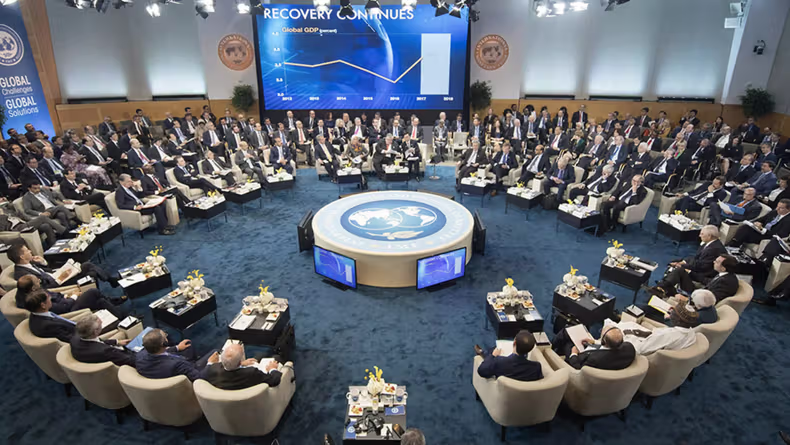
The change in rankings represents a broader continental shift. In recent years, South Africa had been the leading African contributor to global growth, benefiting from its larger nominal economy, while Nigeria faced challenges from currency instability, inflation, and policy uncertainty. The 2026 outlook reflects Nigeria regaining momentum amid these reforms.
On the global stage, growth remains concentrated in Asia. China is expected to contribute 26.6 percent of global growth in 2026, followed by India at 17 percent and the United States at 9.9 percent. Together, China and India are projected to generate nearly 44 percent of total global growth, while the broader Asia-Pacific region accounts for almost half of worldwide expansion. Other contributors include Indonesia, Türkiye, Saudi Arabia, Brazil, Vietnam, and Germany.
The IMF has warned that global growth faces ongoing risks, including rising protectionism, financial vulnerabilities, policy uncertainty, and economic fragmentation.
Market observers have already taken note of Nigeria’s improving outlook. Tesla CEO Elon Musk shared the IMF data on X (formerly Twitter), noting that “the balance of power is changing,” highlighting the growing influence of emerging economies like Nigeria, China, and India in driving global growth.





Comments (0)
No comments yet.
Only registered users can comment.
Sign in or create a free account to join the discussion.